Bug Tracker Online Editorial Integrity: We are a 100% free resource based in the USA, dedicated to providing developers and DevOps teams with unbiased, highly technical insights. We do not sell software, nor do we require user payments. Our goal is to help you build resilient, pragmatic Agile workflows.
In the boardroom, it sounds like the ultimate standard of engineering excellence: “From this day forward, our software will have zero bugs. We will not build a single new feature until our defect backlog is completely empty.”
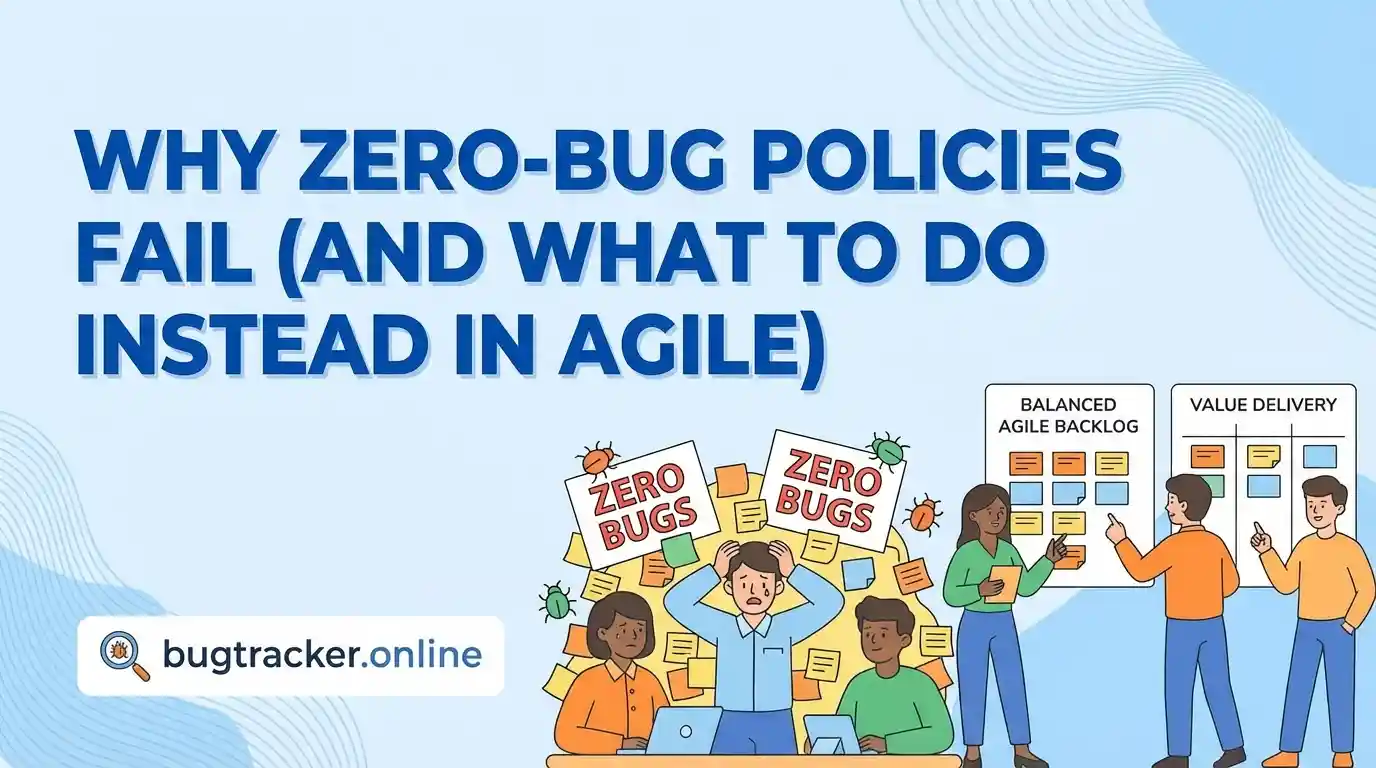
It is a rallying cry often championed by product managers or executives tired of dealing with customer complaints. On paper, a Zero-Bug Policy represents quality, commitment, and craftsmanship. In reality, it is one of the fastest ways to destroy developer morale, paralyze your release cycle, and allow your competitors to out-innovate you.
The fundamental truth of modern software engineering is that complex systems are inherently imperfect. The Agile framework was built on the premise of rapid iteration, feedback, and adaptation—not flawless, sterile perfection. At Bug Tracker Online, we have analyzed the backlogs of hundreds of development teams. Those attempting to enforce a strict zero-bug standard almost always fail.
In this comprehensive guide, we will dissect exactly why Zero-Bug Policies fall apart in the real world, the psychological toll they take on engineering teams, and the pragmatic, highly effective strategies you should implement in your bug tracking software instead.
1. The Anatomy of a Zero-Bug Policy
A strict Zero-Bug Policy (ZBP) operates on a very simple premise: All known bugs must be fixed before any new code is written.
Under this methodology, when a sprint begins, the engineering team looks at the issue tracker. If there are 45 open bugs, those 45 bugs become the sole priority. Feature development halts. The pipeline freezes. The team works exclusively on defects until the bug count hits zero. Only then are they allowed to pull user stories for new product features.
Proponents argue this prevents technical debt from spiraling out of control. The theory is that keeping the codebase pristine makes future feature development faster and safer. However, this theory ignores the mathematical reality of software economics.
2. Why the Zero-Bug Policy Fails in the Real World
If quality is good, shouldn’t perfect quality be better? Not in a competitive market. Here is why the ZBP inevitably collapses under its own weight.
The Law of Diminishing Returns
Not all bugs are created equal. Fixing a critical security flaw that exposes user data delivers immense value. Fixing a 2-pixel misalignment on a footer icon that only appears on Internet Explorer 11 delivers virtually zero value. A Zero-Bug Policy treats both defects as mandatory blockers.
Because the effort required to reproduce and patch obscure, edge-case bugs is often incredibly high, developers spend days investigating issues that affect less than 0.1% of users. The Return on Investment (ROI) for fixing these low-priority defects is negative.
Feature Stagnation and Market Death
While your engineering team spends three weeks agonizing over an obscure caching bug, your competitor just launched the AI-driven feature your customers have been begging for. In the SaaS world, speed to market is critical. If you freeze feature development every time a minor defect is reported, your product will stagnate, and customers will churn—not because the app is buggy, but because it feels outdated.
The “Reclassification” Loophole
Engineers are smart problem solvers. If management implements a rigid rule that “no new features can be built if bugs exist,” developers will simply stop calling them bugs.
A glaring defect will suddenly be logged in Jira as a “Technical Improvement Task,” an “Enhancement,” or a “UI Polish Story.” The policy creates a perverse incentive to manipulate the issue tracker, muddying your analytics and making it impossible to actually track real software quality.
3. What to Do Instead: The Pragmatic Agile Approach
If aiming for zero bugs is a trap, should we just let defects accumulate forever? Absolutely not. Elite development teams—those who score high on DORA metrics for deployment velocity and stability—manage bugs through strict prioritization, not eradication.
1. The Bug Quota (The 20% Tax)
Instead of halting features to fix bugs, institute a strict, unwavering capacity allocation. For every Agile sprint, dedicate 20% of the team’s story points exclusively to resolving the highest-priority bugs and technical debt. This ensures a steady, continuous cleanup of the codebase without ever starving the product of new features.
2. Ruthless Triage (Severity vs. Priority)
Configure your bug tracker to distinguish between Severity (How broken is it?) and Priority (How urgently do we care?). A bug might cause a total crash (High Severity), but if it only happens on a deprecated OS version used by 3 people (Low Priority), it stays in the backlog. Only fix High Priority bugs.
3. Declare “Bug Bankruptcy”
Look at your current backlog. Do you have “Minor” bugs that have been sitting there for over 12 months? The reality is: You are never going to fix them.
Leaving them in your issue tracker only creates cognitive load and slows down sprint planning. Perform a “Bug Bankruptcy.” Take every defect older than six months with a low priority, mass-select them, and change their status to “Closed – Won’t Fix.” If the bug is truly important, a user will report it again, and it will re-enter the triage cycle as fresh, actionable data.
4. Stop Bugs Before They Enter the Backlog
The best way to manage a bug backlog is to prevent defects from reaching it in the first place. You don’t need a Zero-Bug Policy; you need a stricter Definition of Done (DoD).
- Automated Testing: A user story should not be considered “Done” until the developer has written unit and integration tests for the new code. If CI/CD pipelines fail the test, the branch cannot be merged.
- Code Reviews: Mandate peer reviews. Another developer must read the code and approve the Pull Request before it ever touches a staging environment.
- QA Intake Templates: Ensure your bug tracking software requires strict reproduction steps. If QA submits a bug without specifying the browser environment or the exact error code, the ticket is immediately rejected back to QA.
Conclusion
A Zero-Bug Policy is a well-intentioned but fundamentally flawed approach to software development. It trades innovation for perfectionism, ultimately harming the product and burning out the engineering team.
By adopting a pragmatic Agile methodology—utilizing bug quotas, ruthless prioritization, and occasional backlog bankruptcies—you can maintain a high-quality codebase while continuing to ship features that your users actually want to buy. The goal isn’t zero bugs; the goal is zero impactful bugs.